Hue: The Imperial City, the Royal Tombs and the Food of the Nguyen Court
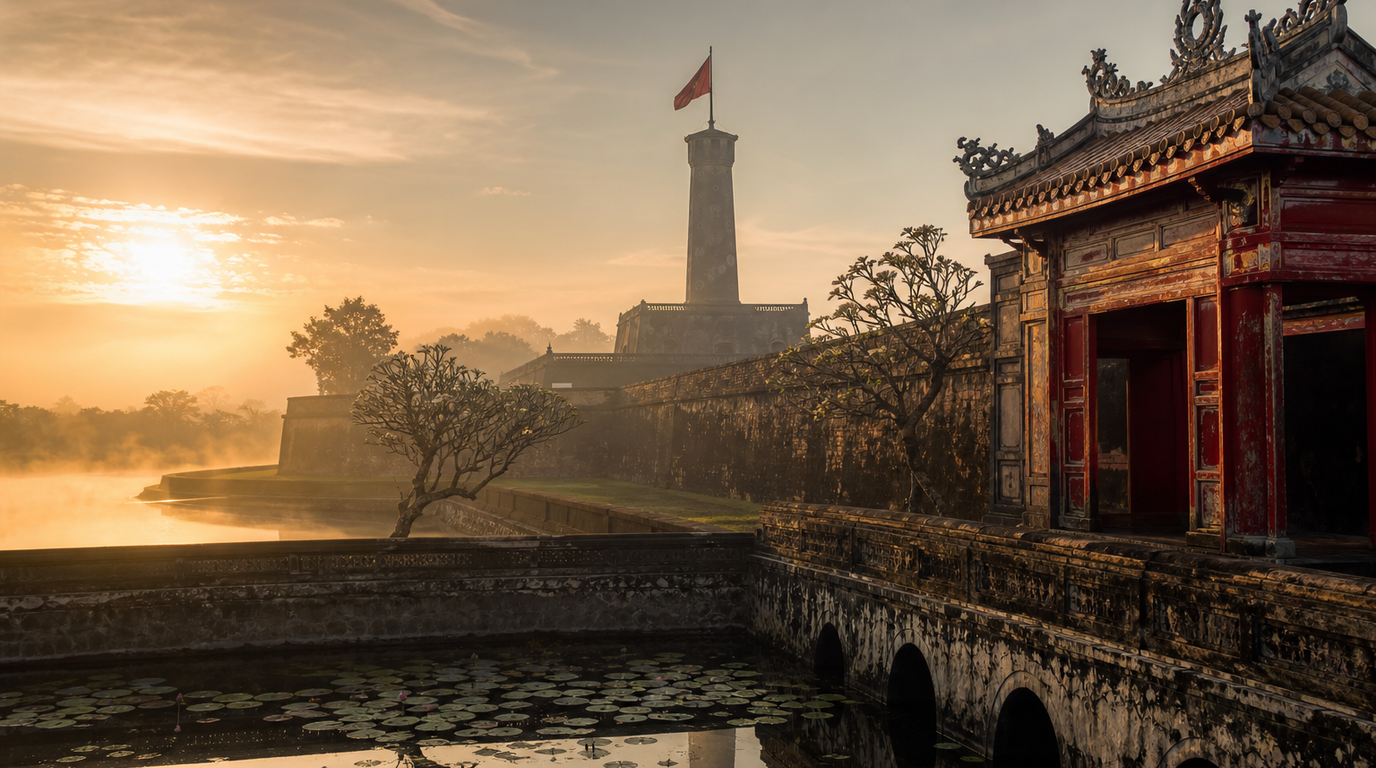
There is a particular hour in Hue, just after dawn, when the Perfume River carries a low mist and the walls of the Citadel emerge from it in stages — first the moat, then the ramparts, then the great flag tower standing over everything. Vietnam has louder cities and prettier beaches, but it has nowhere else that feels quite so deliberately built. For a hundred and forty-three years, from 1802 until the abdication of Emperor Bao Dai in 1945, Hue was the imperial capital and the seat of the Nguyen dynasty, the last royal line to rule Vietnam. The Complex of Hue Monuments became Vietnam’s first UNESCO World Heritage Site in 1993, and the designation covers not just the walled city but a landscape of tombs, pagodas and garden houses scattered along the river for kilometres in both directions. It is a city best taken slowly, and one that repays travellers who arrive expecting history rather than nightlife.
The Imperial City is the place to begin, and it is best understood as a set of nested rectangles. The outer citadel, ringed by a moat and ten kilometres of wall, was laid out on the advice of geomancers and defended in the French Vauban style. Inside it sits the Imperial Enclosure, entered through the ceremonial Ngo Mon gate, and inside that again lay the Purple Forbidden City, reserved for the emperor and his household. Much of that innermost court no longer stands. The Battle of Hue during the 1968 Tet Offensive destroyed the majority of the Forbidden City’s buildings, and what visitors walk through today is a mixture of survivors, patient restorations and open foundations marked out in the grass. The effect is not disappointing so much as unusually honest — the Thai Hoa palace with its red-lacquered columns and the reconstructed royal theatre stand in a landscape that makes no attempt to hide what was lost.
The royal tombs south of the city are, for many travellers, the better half of Hue, and the trick is to choose two or three rather than attempt all seven. Each was designed by the emperor who would occupy it, which makes them unusually revealing portraits. Minh Mang’s tomb is rigorously symmetrical, a Confucian composition of courtyards and lakes arranged along a single axis. Tu Duc built himself something entirely different — a walled retreat of pine, lotus ponds and pavilions where he wrote poetry and escaped the court during his lifetime. Khai Dinh, who reigned in the 1920s, produced the outlier: a blackened concrete hillside monument encrusted inside with glass and porcelain mosaic, gaudy, European-inflected and unforgettable. Upriver stands Thien Mu Pagoda, founded in 1601, whose seven-storey octagonal tower is the image most often used to represent the city.
Hue also eats differently from the rest of the country, a direct inheritance of the royal kitchens and their insistence on many small, precisely made dishes. Bun bo Hue — a lemongrass and chilli beef noodle soup — is the city’s most exported creation, but it is worth ordering banh beo, the tiny steamed rice cakes topped with dried shrimp, and com hen, a bracing rice dish built around the baby clams of the river islands. Dong Ba market, on the riverfront north of the bridge, is the place to try several of them in one sitting, and the stalls at its rear are considerably better than those facing the street. On timing: Hue is one of Vietnam’s wettest cities, with a genuine rainy season from September to December, so February to April is the reliable window. Two nights is enough for the Citadel, a tomb circuit by boat or car, and an evening walk along the river. Most travellers arrive from Da Nang, ninety minutes south, and the road over the Hai Van Pass is the one to take if the weather is clear — the train hugging the coastline below is the other.
Plan Your Vietnam Adventure
Discover our curated tours and airport services for a seamless travel experience.